Advertising & affiliate disclosure: Muscle-Vitality is an independent review website. We do not sell or ship products. Purchase links send you to the official retailer’s checkout on digistore24.com, and we may earn a commission at no extra cost to you. Read the full disclosure · Privacy Policy · Terms of Use.
Advanced Amino Formula: what we found when we read the whole label
A longer, slower look at the formula our editors shortlisted — the science it leans on, what the Supplement Facts panel actually says, who it is a poor fit for, and the questions worth asking before you spend anything.
Written by the Muscle Vitality Editorial Team. Independent review. We do not sell or ship this product.
Important: These statements have not been evaluated by the Food and Drug Administration. This product is a dietary supplement and is not intended to diagnose, treat, cure or prevent any disease. Content on this page is educational only, is not medical advice, and is not a substitute for care from a qualified healthcare professional. This is an independent review site and purchase links are affiliate links.
Why does male vitality decline with age?
There is rarely a single cause. What most men experience after forty is the combined effect of several slow-moving changes — hormonal, nutritional, behavioural and inflammatory — that overlap and reinforce one another. Understanding each one individually makes it much easier to judge which habits, and which products, are actually worth your attention.
3–8%
Muscle mass typically lost per decade after age 30
50+
Age range when the decline tends to accelerate
Testosterone declines gradually, not suddenly
For most men, total testosterone begins a slow decline somewhere in the late thirties or early forties, typically in the range of about one percent per year. Because the change is gradual rather than abrupt, it rarely announces itself. What men usually notice first is something vaguer: workouts that used to feel routine now take an extra day to recover from, the afternoon slump arrives earlier, and body composition drifts even though the diet has not changed much.
Hormones also do not act in isolation. Testosterone interacts with sleep quality, body fat percentage, stress hormones and overall nutritional status, which is why two men of the same age can have very different experiences. A man who sleeps seven to eight hours, trains regularly and eats enough protein often reports steadier energy at fifty-five than a man of forty-five who is chronically under-slept and sedentary.
It is also worth separating normal age-related change from a medical condition. Persistent fatigue, low mood, loss of libido or unexplained loss of strength deserve a conversation with a physician and, where appropriate, blood work. Educational content like this page is not a substitute for that evaluation.
Chronic stress keeps the body in the wrong mode
Stress is useful in short bursts. The problem is duration. When work pressure, financial worry or poor recovery keep cortisol elevated for months at a time, the body prioritises immediate demands over maintenance work such as tissue repair and muscle building. Many men describe this as feeling 'wired but tired' — mentally busy yet physically flat.
Sustained stress also tends to spread into other habits. It shortens sleep, increases reliance on caffeine and convenience food, and makes training feel like one more obligation rather than a release. Each of those knock-on effects independently influences energy and recovery, so the cumulative impact is larger than stress alone would suggest.
Poor sleep undermines recovery and hormone balance
A large share of the body's repair work happens during sleep. Growth hormone release, muscle protein turnover and the consolidation of training adaptations all depend on getting enough deep and REM sleep. Research on sleep restriction has repeatedly found measurable drops in daytime testosterone in healthy young men after only a week of shortened nights.
Sleep quality often deteriorates with age for practical reasons rather than mysterious ones: more night-time waking, more evening alcohol, later screen exposure, and conditions such as sleep apnoea that become more common after midlife. Addressing those causes usually produces a bigger change in how a man feels than any single product.
If you snore heavily, wake unrefreshed most mornings or feel sleepy during the day despite adequate time in bed, ask a doctor about a sleep assessment before assuming the issue is hormonal.
Diet: protein quality matters more with age
Older adults are generally less efficient at converting dietary protein into muscle tissue, a phenomenon researchers call anabolic resistance. In practical terms, the same steak that supported muscle maintenance at twenty-five does slightly less work at sixty. Most nutrition bodies therefore suggest that older adults spread protein across meals rather than concentrating it in the evening.
Micronutrients play a supporting role. Vitamin D, magnesium and zinc are among the nutrients most frequently reported as low in older men, and each is involved in muscle function, sleep or normal hormone production. Correcting a genuine shortfall can make a noticeable difference; taking large amounts when levels are already adequate generally does not.
The most reliable dietary pattern remains unglamorous: sufficient total calories, adequate protein at each meal, plenty of vegetables and fibre, and limited ultra-processed food. Supplements are best understood as a way of filling gaps in that pattern, not replacing it.
Low-grade inflammation quietly interferes
Ageing is often accompanied by a modest, persistent rise in inflammatory signalling, sometimes described in the literature as inflammageing. It is far milder than the inflammation of an injury or infection, but because it is continuous it can interfere with muscle repair and contribute to the general sense of feeling run down.
Excess visceral fat, poor sleep, smoking and a diet low in fibre and unsaturated fats all push in that direction, while regular movement, adequate sleep and a varied diet push the other way. This is one of the clearer examples of how lifestyle factors compound rather than act separately.
Inactivity accelerates everything else
Muscle responds to demand. When demand falls, muscle mass and strength follow, and the loss is measurable within weeks of reduced activity. Adults commonly lose in the region of three to eight percent of muscle mass per decade after thirty, and the rate tends to accelerate after fifty — but a substantial share of that decline reflects reduced loading rather than age itself.
This is also the most encouraging factor on the list, because it is the most modifiable. Studies of resistance training in adults in their sixties, seventies and eighties consistently show gains in strength and function. Nothing else discussed on this page has as much evidence behind it as simply lifting something heavy two or three times a week.
Lifestyle habits that support healthy vitality
Before considering any product, it is worth being honest about the fundamentals. The habits below have the strongest and most consistent evidence behind them, they cost little or nothing, and they influence how well anything else you add will work.
Resistance training two to three times a week
Loading the muscles is the single most evidence-backed way to preserve strength and function with age. Adults commonly lose 3–8% of muscle mass per decade after 30, and the rate tends to accelerate after 50 — but resistance training can slow or reverse that trend.
Two or three sessions a week covering the main movement patterns — a squat or leg press, a hinge, a push, a pull and something for the core — is enough for most people to maintain and often improve.
Progress does not require heavy barbells. Machines, resistance bands and bodyweight work all produce adaptation as long as the effort is genuine and increases slowly over time. If you are new to training or returning after a long break, a few sessions with a qualified coach is a reasonable investment in avoiding injury.
Protein spread across the day
Because older adults extract less muscle-building signal from a given amount of protein, distribution matters. Aiming for a meaningful serving at breakfast, lunch and dinner tends to work better than one large portion in the evening, which is how many people naturally eat.
Whole foods should do most of the work: eggs, fish, poultry, dairy, legumes, tofu and lean meat. Supplements are a convenience tool for the meals where hitting that target is genuinely difficult, not a replacement for the plate.
Protecting sleep as seriously as training
Consistent bed and wake times, a dark cool room, limited alcohol in the evening and a wind-down period without screens are unglamorous but effective. Most adults function best somewhere between seven and nine hours, and the effect of restoring an hour of sleep is often larger than anything found in a supplement aisle.
Persistent insomnia, loud snoring or unrefreshing sleep are medical issues rather than willpower issues. They are worth raising with a doctor because untreated sleep apnoea in particular is strongly associated with fatigue and low testosterone.
Managing stress in a way you will actually repeat
The specific method matters less than consistency. Walking outdoors, breathing exercises, prayer or meditation, time with friends and deliberate breaks from work all lower the physiological load. What does not work is planning an elaborate routine you abandon after ten days.
Recovery deserves the same planning as training. Scheduling lighter weeks, keeping one genuinely free day and stopping caffeine by early afternoon are small structural changes that reduce cumulative strain.
Filling genuine nutrient gaps
Vitamin D, magnesium and zinc are the nutrients most often found low in older men, and each has a defined role in muscle function, sleep quality or normal hormone production. Blood work is the honest way to know whether you are short of any of them.
Supplementing a real deficiency is worthwhile. Supplementing above a level your body can use generally is not, and in the case of minerals such as zinc, excessive intake carries its own problems. More is not better; adequate is better.
How the body uses dietary protein differently after 55
Adults typically lose 3–8% of their muscle mass per decade after 30, and the rate accelerates after 50. The clinical term for this age-related loss of muscle mass and function is sarcopenia. Less muscle means less strength, a slower metabolism, and reduced balance and mobility — which is why the change matters for everyday life.
From roughly the fourth decade onward, the body also becomes measurably less efficient at turning dietary protein into muscle tissue. Researchers describe this as anabolic resistance: the same steak, the same shake, the same plate of eggs produces a smaller muscle-protein response at 60 than it did at 30. Nothing has gone wrong — digestion, absorption and hormonal signalling simply become less responsive with age.
The practical consequence is that eating more protein is not always the whole answer. Larger portions add calories and digestive load, and a meaningful share of that protein is broken down for energy or excreted as nitrogen waste rather than used as structural raw material. This is why essential amino acids — the eight building blocks the body cannot synthesise on its own — have become a subject of interest in nutrition research on healthy ageing.
How free-form amino acids differ from whey and BCAAs
Whey protein must be digested and broken down into amino acids before anything can be used. That process works, but it is slower and less complete in an older digestive system. Free-form amino acids skip that step: they are already in the form the body transports and uses, so they place far less demand on digestion.
BCAA products, the other common category, supply only three of the eight essential amino acids — leucine, isoleucine and valine. Building a complete protein requires all eight to be present; missing even one limits what the body can assemble, in the same way a missing part limits an assembly line. Muscle protein synthesis is triggered when all essential amino acids are available in the bloodstream at the same time, in sufficient amounts. That is the core argument for a complete essential amino acid profile rather than a partial one.
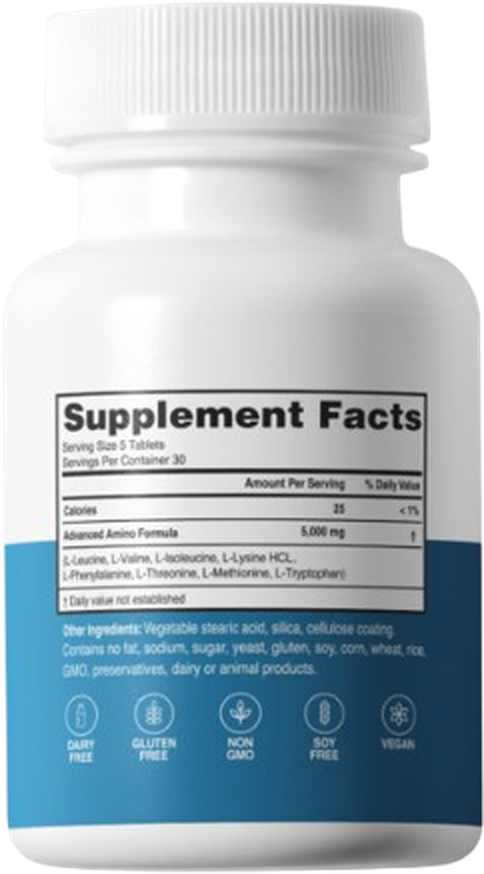
What the panel says Serving size five tablets, thirty servings per container, 5,000 mg of the formula per serving, 25 calories. The eight essential amino acids are named in full: L-leucine, L-valine, L-isoleucine, L-lysine HCL, L-phenylalanine, L-threonine, L-methionine and L-tryptophan. No proprietary blend hides the composition.
How we assessed it
We applied the same five editorial criteria we use for every formula in this category. Advanced Amino Formula met all five:
All eight essential amino acids listed individually, not hidden in a blend
Free-form aminos, which require no protein digestion before absorption
A disclosed amount per serving (5,000 mg across five tablets)
No soy, dairy, gluten or GMO ingredients
Manufactured in the USA in a GMP-certified facility
Who it is not for
A complete review has to include this part. If you are pregnant or nursing, under 18, managing kidney or liver disease, on protein-restricted medical nutrition, or taking medication that interacts with amino acid intake — including certain antidepressants, where tryptophan matters — this is a conversation for your doctor before it is a purchase decision. The same applies if you have phenylketonuria, given the phenylalanine content.
It is also not a substitute for resistance training. Every credible body of research on muscle maintenance after 55 points to the same conclusion: nutritional raw material matters, but the signal to use it comes from loading the muscle. A supplement taken without any activity is unlikely to do much on its own.
Our verdict
Judged strictly on label transparency, formulation logic and value per serving, Advanced Amino Formula is the strongest option we reviewed in this category. It discloses every ingredient and amount, uses free-form aminos suited to an ageing digestive system, and carries a clean allergen profile with a 90-day satisfaction policy from the manufacturer (terms and conditions apply).
That is a judgement about the product, not a promise about your results. It is a dietary supplement intended to complement a balanced diet and regular activity. It is not intended to diagnose, treat, cure or prevent any disease, and individual experience varies.
If the formula fits what you are looking for, current pricing on the manufacturer’s own website is listed below for reference. Pricing, shipping and the satisfaction policy are set entirely by them.
What to look for in a supplement
If you decide a supplement has a place alongside your diet and training, the five points below are the criteria our editorial team applies to every product we examine. They are worth applying yourself, whatever you end up choosing.
1.Ingredients you can look up
A credible formula uses ingredients with published research behind them, listed by their recognised names rather than marketing terms. If you cannot type an ingredient into a medical database and find anything about it, that is a meaningful signal.
Be equally sceptical of very long ingredient lists. A label with thirty components at token amounts is usually designed to look impressive rather than to do anything measurable.
2.Full label transparency, no proprietary blends
The Supplement Facts panel should state the exact amount of each active ingredient per serving. A 'proprietary blend' hides the individual doses inside a single total, which makes it impossible to compare the product against the studies it references.
Once you can see the amounts, compare them with the doses used in research. A product can contain the right ingredient at a quantity far too small to matter.
3.Manufacturing standards you can verify
Look for manufacturing in a facility that follows Good Manufacturing Practice standards, and for third-party testing of identity, potency and contaminants. Supplements are regulated as food rather than medicine in the United States, so responsibility for quality control sits largely with the manufacturer.
Reputable companies state where the product is made, how it is tested and how to request a certificate of analysis. Vague claims about 'the highest quality' with no specifics tell you nothing.
4.Claims that stay within the evidence
Legitimate supplement marketing describes support for normal body functions. Language promising to cure, treat or reverse a condition, or guaranteeing a specific result in a specific number of days, is both a regulatory problem and a reliability signal.
The same applies to urgency: countdown timers, invented scarcity and 'today only' pricing are sales devices, not indicators of product quality.
5.Reviews read carefully, and a real returns policy
Customer feedback is useful for practical detail — taste, capsule size, how the ordering and refund process actually went — and much less useful as evidence of effect. Look for patterns across many reviews rather than individual dramatic stories.
A clear, generous and genuinely honoured refund policy matters more than any testimonial, because it shifts the risk of trying a product away from you. Read the terms before ordering, including who pays return shipping and what the deadline is.
What the formula is designed to complement
May help support lean muscle maintenance
Supplies a complete essential amino acid profile your body uses as nutritional raw material for lean muscle after 55.
Formulated to complement post-activity nutrition
Intended to complement your usual nutrition after walks, tennis, gardening or gym sessions, as part of a healthy routine.
May help support everyday nutrition goals
Designed to complement general wellness routines when combined with a balanced diet and regular activity. Individual experience varies.
Essential means your body cannot make them. They must come from food or supplementation — and the body uses dietary protein less efficiently with age.
L-Leucine
Branched-chain essential amino acid
L-Lysine
Essential amino acid found in dietary protein
L-Valine
Branched-chain essential amino acid
L-Isoleucine
Branched-chain essential amino acid
L-Phenylalanine
Essential amino acid involved in normal nutrition
L-Threonine
Essential amino acid found in protein foods
L-Methionine
Essential sulfur-containing amino acid
L-Tryptophan
Essential amino acid found in dietary protein
No proprietary blends
Every amino acid is listed with its exact amount per serving, so you know precisely what you are taking. The manufacturer states it is produced in the USA in a GMP-certified facility.
Every product we review is scored from 0 to 10 on the seven criteria below, and the weighted total produces its editorial score. This is a documentation and formulation review — we read labels and published materials, we do not perform laboratory testing. Affiliate commissions are never an input to a score.
25%
Ingredient transparency
Every active ingredient must be named individually with its amount per serving. Proprietary blends that hide amounts lose points.
20%
Label accuracy
Marketing copy is compared line by line against the Supplement Facts panel. Claims the label does not support reduce the score.
15%
Manufacturing standards
Where the product is made, whether the facility is described as GMP-certified, and whether the manufacturer publishes that information.
12%
Refund policy
Length of the satisfaction window, clarity of the conditions, and whether the terms are published before checkout.
12%
Value per serving
Cost per daily serving compared with other products supplying a comparable ingredient profile.
10%
Public reputation
Recurring themes across publicly available customer feedback, company history and how complaints are handled.
6%
Third-party certifications
Independent testing, allergen or non-GMO certifications, counted only when the manufacturer documents them publicly.
Product materials describe the formula as built around a simple nutrition concept: supply all eight essential amino acids in free form rather than relying on a large protein powder serving. We report this as information published by the manufacturer.
We present this as manufacturer-provided product context. It is not medical advice, not a health-professional endorsement, and not a claim about health outcomes. Always review the Supplement Facts panel and ask a healthcare professional whether a supplement fits your needs.
The manufacturer’s 90-day satisfaction policy
The manufacturer allows a 90-day window to evaluate the product. Refund eligibility, deadlines, return conditions and any shipping or handling costs are defined by the manufacturer and the external retailer, not by this website. Terms and conditions apply and may change without notice — always read the current policy on the retailer’s checkout page before ordering.
Muscle Vitality is an independent educational website dedicated to helping adults make informed decisions about muscle health and nutritional supplements. We publish plain English explanations of the research, compare product labels side by side, and share which formulas we believe offer the best value.
We do not manufacture, sell or ship supplements. We are not affiliated with or endorsed by any supplement brand. When we recommend a product, purchases are completed on the manufacturer’s own website, and we may earn an affiliate commission at no extra cost to you.
Educational first
We explain the science behind muscle health so readers can judge products for themselves.
Written for adults 50+
Our reviews focus on strength, mobility, recovery and healthy aging — not bodybuilding trends.
We do not make supplements
Muscle Vitality does not manufacture, own, sell or ship any product. We review what others make.
Current pricing listed on the official retailer’s site
For reference only. We do not sell this product — pricing, availability, shipping and the 90-day satisfaction policy (terms and conditions apply) are set and fulfilled by the manufacturer on their own website. Links may be affiliate links. See our Privacy Policy and Terms of Use.
Affiliate disclosure: this is an independent review page. The buttons below are affiliate links to the official retailer’s checkout, and we may earn a commission at no extra cost to you. This product is a dietary supplement, not a medicine, and is not intended to diagnose, treat, cure or prevent any disease.
This page is intended for informational purposes only and should not be considered medical advice. Individual results may vary. Always consult a qualified healthcare professional before starting any supplement, particularly if you are managing a health condition, taking prescription medication, or planning a surgical procedure.
Statements about dietary supplements on this page have not been evaluated by the Food and Drug Administration. No product discussed here is intended to diagnose, treat, cure or prevent any disease.